


How to Choose the Right Oil for Bearings

Updated: Feb 21
In the company where we work, there are dozens, perhaps hundreds, of different pieces of equipment. And depending on the variety of machinery used in production, there are many moving or rotating components.
It is certain that bearings are used in 99% of these points. And we have to lubricate them at certain intervals to ensure their continuous movement.
For this, at the very least, an equipment-based lubrication list should be created. The basics of a lubrication system involve 5 main points/questions (Where, When, How much, Which, How often).
Below, I will try to answer the question:
How to Choose the Right Oil for Bearings?
Many maintenance workshops have a storage cabinet for bearings, which we strive to keep relatively cleaner than other spare parts. Storing bearings is more important than storing other spare parts.
There is also another shelf for easy access to oils and grease pumps. However, we rarely use more than two or three types of grease. Furthermore, if there are supply problems, only one type of grease is used throughout the entire factory.
But this shouldn't be the case…
If we want our bearings to function for many hours, we must use oil suitable for the bearing type and operating conditions.
Oil selection criteria are described in the ISO 281:78 standard. At this point, we need to know one constant: the Kappa (K) constant.
Geri bildirim gönder
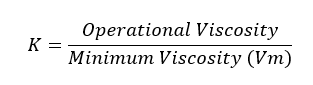
This formula explains the relationship between oil film thickness and oil viscosity. The limiting value here is K=1. Below this value, the oil film is affected, and metal-to-metal contact becomes inevitable.
Kappa = 0,7 Kappa = 1 Kappa =4

I have tried to explain how to optimize the selection of the K value in the rest of the article.
In addition, the oil film thickness is also affected by operating conditions. Contamination, chemicals, and temperature are influencing factors.
According to studies on optimizing the Kappa constant, the Kappa value for oil selection is taken as 4.
To find the operating viscosity in oil selection, we first need to know the minimum viscosity (Vm).

In the formula, the average pitch diameter (dm) is represented by the outer diameter (OD) and the inner diameter (ID). (n) indicates the rotational speed.
Using these equations, we can quickly calculate the minimum viscosity value of the oil we will use for our bearing.
If you are not interested in the calculation and want an easier method, you can use the table below to find the Vm value.
In the example in the table, the Vm value for a bearing with a pitch of 400 mm dm and rotating at 500 rpm is calculated as 10 cst.

The next step is selecting the appropriate oil based on the ambient temperature.
For Kappa value optimization, we take the K constant as 4 and multiply the 10cst we found by this value to arrive at an operating viscosity of 40cst.
In this example, assuming an ambient temperature of 75°C, we determine the viscosity of the oil we need to use to achieve an operating viscosity of 40cst with the help of the graph below.

When we plot the values on the graph, it shows that we need to use oil with an ISO viscosity rating of 150 for this bearing.
In conclusion, it should be reiterated that we need to use the same oil for every bearing in our spare parts cabinet, and increase the variety of oils depending on the size and operating temperature.


Comments